Explore funded projects, research projects, and PhD student projects across agricultural robotics, marine systems, conservation, healthcare AI, and intelligent manipulation.
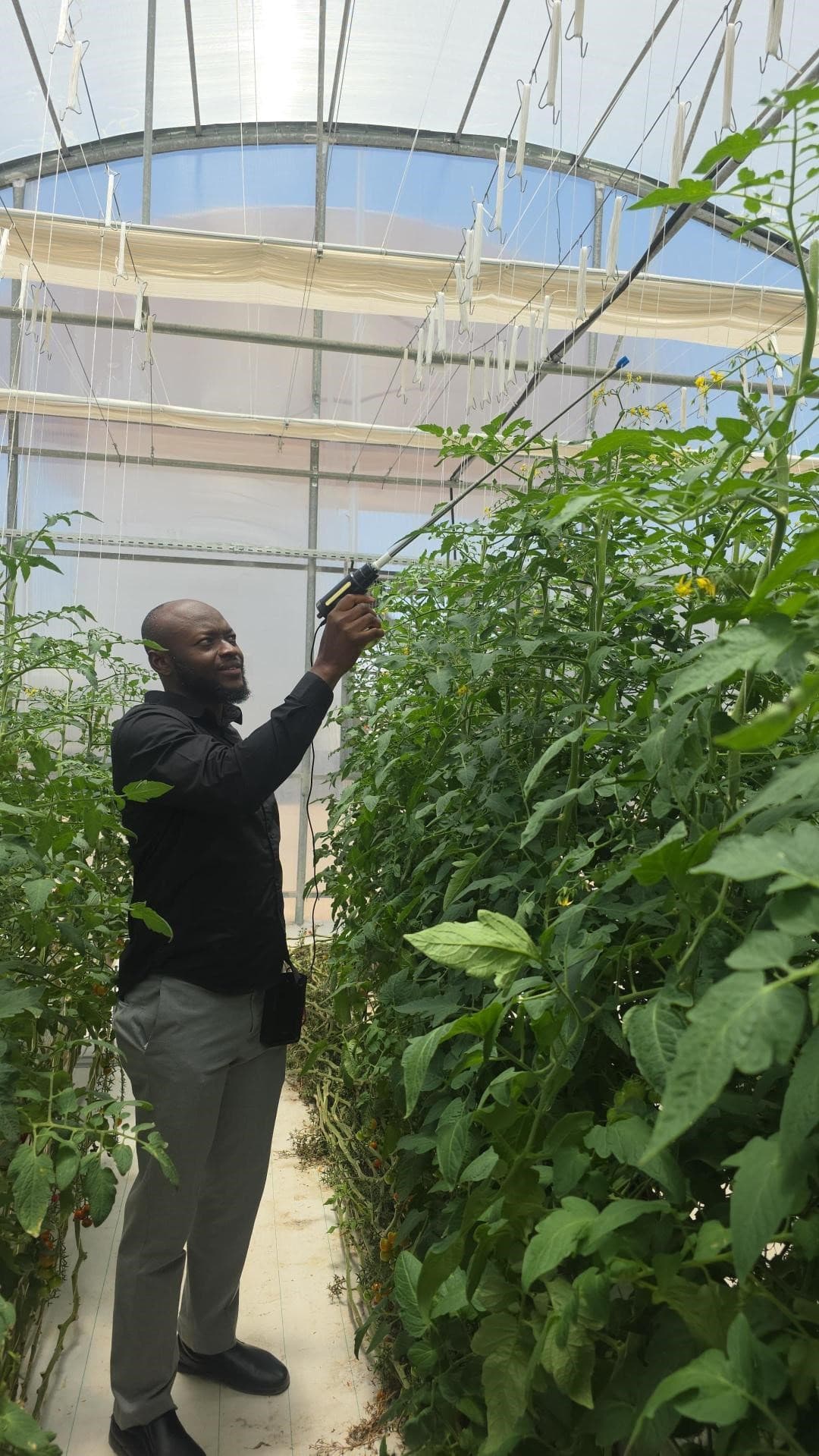
TouchRIPE is the UAE’s first wearable, non-destructive device for assessing fruit ripeness, developed, built and patented\ at Khalifa University. It mimics human palpation to measure fruit firmness directly on the tree within seconds, enabling accurate harvest decisions, reducing post-harvest waste, and extending shelf life.
PollenMATIC is a handheld artificial pollination solution designed to provide reliable and controlled pollination in greenhouse crops. The device generates bee-like vibrations that promote pollen release and transfer, helping to improve pollination consistency while reducing dependence on natural pollinators and manual methods
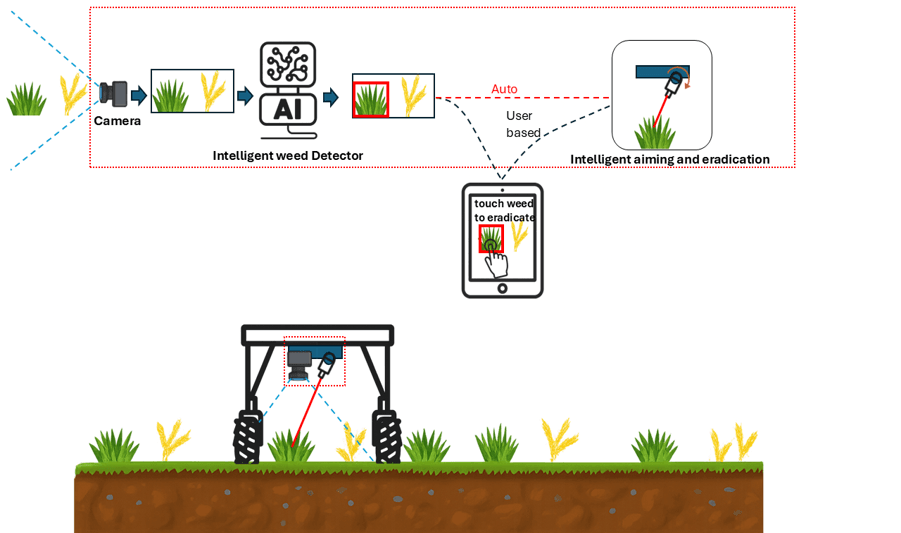
This project develops a modular, AI-enabled laser weeding system for precise, selective, and chemical-free weed management in quinoa cultivation. The system addresses limitations of manual, chemical, mechanical, and row-dependent robotic weeding by enabling targeted weed removal while reducing labor requirements, environmental impact, soil disturbance, and potential crop damage.
The project is developing a heterogeneous marine robotic system that integrates unmanned surface vehicles (USVs) and autonomous underwater vehicles (AUVs) for autonomous inspection and monitoring. By enabling collaboration between these platforms, the system will support persistent autonomy during long-duration marine missions while advancing sustainable ecosystem monitoring, particularly for coral reefs, biodiversity, and overall environmental health.
AerialYield is an AI powered precision agriculture platform designed to automate crop monitoring and yield estimation in greenhouse environments. It uses drone and field imagery with computer vision models to detect, count, and classify crops such as blueberries and tomatoes by ripeness stage. The results are integrated into a dashboard to support yield assessment, harvest planning, and data driven farm
Plant-AI is a Platform, supporting a Mobile App which integrates with a Dashboard. Using Plant-AI Agronomist or Scouting Staff can capture Pictures and Other forms of Data inside various Crops, Plants in Greenhouses or Outdoor Farms. We incorporate SOTA AI Features including:•Advanced Vision Models•Detection Models•Multi-Modal Frameworks•Multi-Ai Agent FrameworksTo Address Plant Health. Primarily we now use Cameras for Analyzing Plant Leaf Health. We aim to use Mobile App Initially to Capture Data and using AI get results in Real-time and showcase all this data, and temporal information and AI based remedies & Suggestions on Greenhouse Monitoring Platform (Dashboard). The goal is Highly Accurate AI based Estimations/Results of Plant Health.This system is trained on real data from UAE based Greenhouses and is primarily built for the Gulf Region environment.
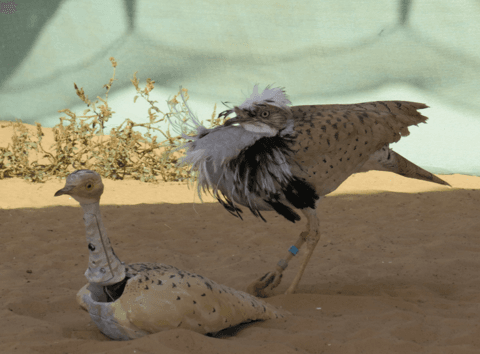
The Houbara Robotics and AI Project develops biomimetic robotic systems and intelligent perception tools to support conservation, behavioural monitoring, and assisted breeding. It integrates HuBot, a bird semen collection device, computer vision, bird detection and tracking, vegetation classification, behavioural analysis, autonomous bird tracking, and long-range remote monitoring to enable safer and more efficient conservation operations.
The Fruit Sorting Robot is an intelligent robotic system designed for automated fruit ripeness classification and sorting. The robot integrates a depth camera for 3D visual perception and a robotic stretch arm equipped with a custom gripper and tactile sensor for ripeness assessment. It classifies fruits into categories such as Underripe, Ripe, and Overripe, ensuring accurate, non-destructive quality assessment.
Fruit harvesting requires complex manipulation where fully autonomous robot learning risk violating safety constraints such as joint limits and self-collision. While human guidance can help, existing methods rarely provide clear haptic feedback that prevents issuing unsafe commands. We present a bilateral teleoperation framework that delivers transparent, constraint-aware haptic cues in human-guided robot learning: as the robot nears a safety boundary, a push–pull force is applied to the operator’s hand to discourage unsafe motions. This enables safer and more effective human demonstrations, helping robots learn complex harvesting behaviors while maintaining safety limits.
OmniRIPE is a compact, modular fruit assessment device designed for fast, non-destructive firmness and ripeness evaluation from farm to shelf. Using controlled perpendicular palpation, vision-based tactile sensing, and AI, it delivers consistent results across handheld, conveyor, and retail applications, enabling objective harvest, sorting, quality, and shelf-life decisions throughout the supply chain.
HumaRipe presents a humanoid mobile manipulation framework for autonomous tomato ripeness assessment in greenhouses. A see-then-touch cascade first uses RGB-D vision to locate and estimate fruit maturity, then dual-arm tactile interaction verifies ripeness. Omnidirectional mobility, LiDAR, and onboard cpu computing enable human-like perception, navigation, inspection, and reliable harvesting decisions.
Quality-aware fruit handling is difficult because robots must localize produce and assess firmness during motion. PackRIPE is a human-inspired closed-loop tactile–vision framework combining AI-based perception, reinforcement-learning grasping, and tactile firmness estimation. Using robotic palpation data from 109 UAE tomatoes, it integrates inspection with handling to support packaging or rejection
TeleRIPE is a VR-based robotic teleoperation system for remote fruit assessment and harvesting. It tracks the operator’s hand movements through a VR headset and WEART haptic gloves, enabling the robotic manipulator and gripper to follow the same movements in real time while providing tactile sensations for natural fruit interaction and ripeness assessment.
This project develops an LLM-guided framework for generating realistic, structured, and clinically meaningful multimodal medical data to overcome data scarcity in healthcare AI. By synthesizing annotated imaging datasets with controllable disease characteristics, it supports the development, training, validation, and benchmarking of advanced robust computer-aided diagnosis and medical data analysis systems.
PhenoAgent is an LLM-driven multimodal system for precision ripeness mapping, yield estimation, and predictive harvest planning in indoor densely fruited crops. It integrates aerial, mobile, ground-based, and environmental sensing to provide adaptive crop monitoring, ripeness-aware yield prediction, actionable harvesting recommendations, and pre-harvest loss mitigation in GPS-denied farming environments.
ProAct-VLM is an adaptive task-planning framework for dynamic, long-horizon robotic manipulation. It integrates Vision-Language Models with a real-time perception–feedback loop to continuously monitor environmental changes and trigger replanning before failures occur. Evaluations across multiple VLM backbones demonstrate improved task success rates, adaptability, and execution efficiency compared with reactive planning approaches.
An algorithm that replicates the visual assessment process used by marine biologists to fully automate coral bleaching evaluation with color-reference charts. The method segments the coral, isolates CoralWatch quadrants, and assigns each coral pixel to the closest reference grade by color similarity, generating pixel-level bleaching visualizations and reporting bleaching percentage.